

Three uplifting women who bucked dismissal & delivered on their awesome ideas
Be grateful they were strong & spoke up!
A late one this week. My brain went on strike, more accurately on “medical leave”. Sucks, but (sh)it happens.
Too often ideas get dismissed not because they lack merit but because of their source: a woman. Patriarchal gender biases still cause many excellent ideas to be dismissed, go ignored. Depriving the world of their benefits.
Why these women inspire me
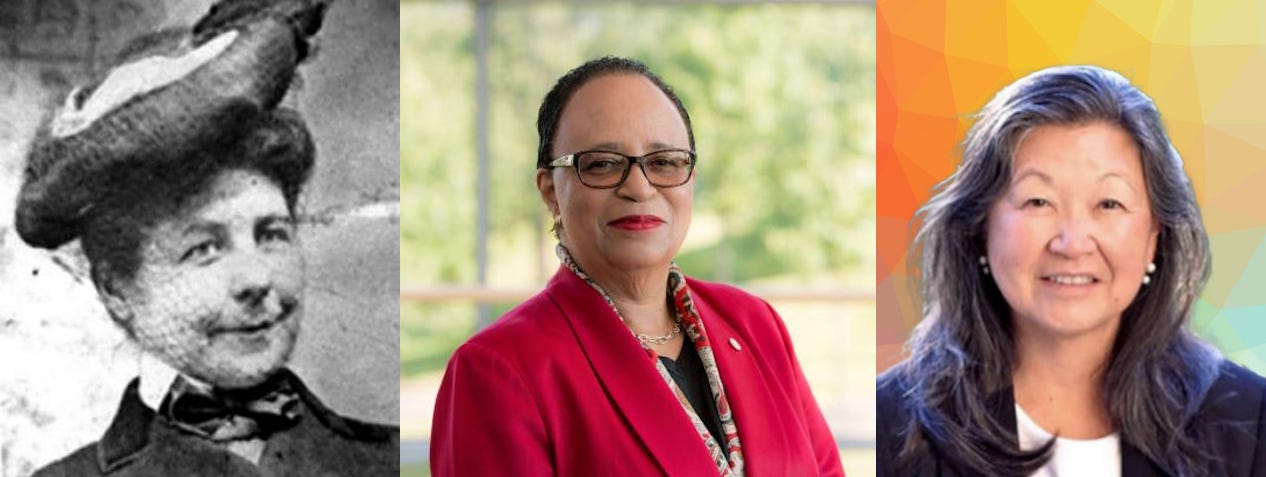
Mary Anderson, Shirley Ann Jackson, and Ann Tsukamoto.
Three women you probably never heard of (unless you’re in their respective fields).
Three women whose ideas the culture surrounding them wasn’t eager to hear.
Three women who pushed past being ignored and dismissed.
They delivered. Created what we take for granted now.
Their research and inventions shaping much bigger fields than people imagined they would at the time.
Three indispensable women contributors who are still little-known.
And, infuriatingly, if I were to ask you who created what they did, you’d probably come up with the three male names.
Even women would.
Heck, if asked before researching this piece, I would have.
Because we suffer from the same conditioned biases as men do. The fact that I enjoy and am surprised at the same time seeing a woman in a “man’s” job says enough.
That’s why I like to tell these stories.
Because they’re uplifting and do a lot of bias-countering.1 Though I do hesitate to do so sometimes.2

Why you want to think of and thank them
Mary Anderson: You want to think of her every time you drive in the rain and turn on your windshield wipers. She invented (and patented them all the way back in 1903) having seen drivers struggling in bad weather.
Shirley Ann Jackson: You want to think of her every time you pick up your phone and see who’s calling or put a call on hold to answer another coming in. She invented caller ID and call waiting.
Ann Tsukamoto: You want to think of her every time you are (or someone you love is) treated with a regenerative medical procedure or taking medicine for a blood disease.
How they persevered and kept contributing
All three women are uplifting and inspiring to me.
They refused to self-censor.
They trusted their own observations and spoke up about it.
They refused to be censored and give up when they faced a culture indifferent to their ideas (because they came from a woman, if you even doubted that).
And they didn’t stop there. They kept building after the first win.
Mary Anderson
We take windshield wipers for granted now, but Mary Anderson instigated the concept she delivered on with them: safer visibility in bad weather. No one back then thought it was a problem that could be solved! She proved it was and could.
She didn’t stop with sketching her idea. She got the patent (1903). She went around to manufacturers to get it into production. They all rejected it. No commercial value (cars were still a rarity then).
Windshield wipers only became standard mass produced standard issue after her patent ran out in 1920…
Mary Anderson put car and driver safety on the map and expectations and requirements around it have only grown broader since.
Shirley Ann Jackson
Shirley Ann Jackson’s work on semiconductors and optical-physics fed into solar-cell development. We wouldn’t be enjoying solar energy quite the same way without her contribution.
She didn’t restrict herself to that field.
She served as chairman on the US Nuclear Regulatory Commission (appointed by Bill Clinton), chairperson of the International Regulators Association, and led the Rensselaer Polytechnic Institute as its 18th president.
More important (to me definitely) than the exact roles, she broke a lot of barriers in STEM and influenced science policy, nuclear safety, and higher education leadership.
Ann Tsukamoto
Ann Tsukamoto stem-cell work opened doors to several treatments like treatments for blood cancer and recovery after damaging chemotherapy.
She also contributed to applying stem-cells in liver tissue and damaged neural tissue, like for spinal cord injuries and neurodegenerative diseases.
She holds 13 patents. Not surprising then that her work became foundational for and shaped the field of regenerative medicine and influenced advancements in gene therapy and tissue engineering.
Share your own irrepressibility!
They were irrepressible. Without a doubt.
They trusted themselves, trusted a simple observation, and built something (a lot of somethings) useful despite living and working in a culture not eager to listen to their ideas — too often not because they lacked merit but because of their female source.
How irrepressible are you?
When was the last time you stuck to your guns ideas, didn’t back off, and (eventually) reaped the rewards? The satisfaction and confidence of accomplishment? Maybe (finally) even validation and recognition?
Share them here in the comments!
Positive role models have power beyond your wildest imagination far into the future.
Gender and race biases have been shown to be particularly persistent. The only thing that has been shown to counter biases (race biases specifically, but I think it’s safe to generalize the finding) are positive role models that flip the script on them.
My fear is that by telling many of them, I’d give you the impression that biases are no longer an issue. And nothing is farther from the truth.